19. Invention, intellectual property and income
1. Project summary
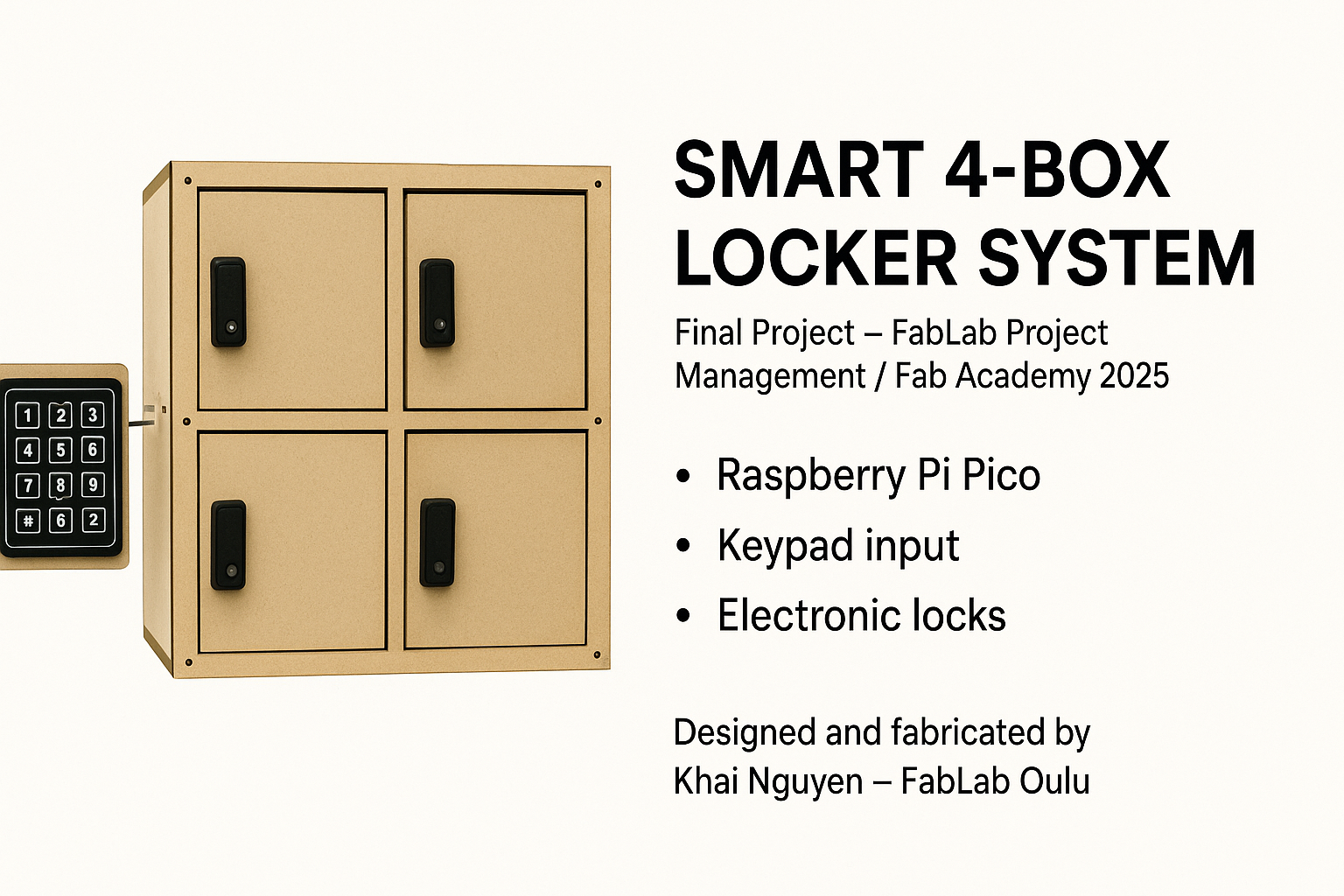
My final project is a smart modular locker system made up of four connected boxes, each with an electronic lock controlled by a Raspberry Pi Pico. The system uses a shared keypad for 6-digit access codes, allowing users to open a specific locker by entering their assigned code.
This project combines digital fabrication, electronics, and programming — showcasing how open-source hardware and FabLab tools can create practical, low-cost storage solutions for makerspaces, schools, or small offices.
2. Target audience
FabLab students and instructors learning digital fabrication and embedded systems.
Educational institutions that want to create their own smart storage systems.
Makers and hobbyists who are interested in IoT-style projects without high cost.
Fab Academy community for knowledge sharing and inspiration.
3. Dissemination Channels
To raise awareness and share my work, I plan to use the following channels:
1.GitLab Repository
Full open-source documentation, CAD files, circuit diagrams, 3D models, code, and photos.
Repository will include:
-
Step-by-step fabrication guide.
-
Wiring and programming documentation.
-
Assembly instructions and BOM (Bill of Materials).
-
Licensed under Creative Commons Attribution-ShareAlike (CC BY-SA 4.0).
2.Fab Academy Student Page
A summarized project description with a link to the GitLab repository.
Embedded video (presentation.mp4) and summary slide (presentation.png).
3.FabLab Oulu Community
Present the working prototype during open sessions or demo days.
Share the design with other students for replication or improvement.
4.Online Platforms
Post photos and build progress on FabLab Discord, Mastodon, or Instagram.
Optionally upload 3D and laser-cut files to Thingiverse or Printables for public use.
4. License and Intellectual Property
License Type: Creative Commons Attribution-ShareAlike 4.0 (CC BY-SA 4.0)
Reason:
-
Allows others to freely use, modify, and redistribute the project with credit.
-
Keeps the project open-source in line with FabLab values.
-
Encourages collaborative improvement across different labs.
For the source code running on the Raspberry Pi Pico, I may also include an MIT License for software components.
5. Future Development and Opportunities
| Area | Possibility | How to Make It Probable |
|---|---|---|
| Networking | Connect lockers to Wi-Fi for remote code generation or app control. | Upgrade to ESP32 or add Wi-Fi module to Raspberry Pi Pico. |
| Sensors | Add door sensors to detect open/close status. | Use magnetic switches or IR sensors for feedback. |
| Display | Show locker number or code entry on an LCD/OLED. | Add I2C display module and update software. |
| Educational Kit | Turn the project into a teaching tool for FabLabs and schools. | Package documentation and create pre-cut kits. |
| Small Business Model | Sell laser-cut kits or offer workshops. | Create pricing plan and assembly instructions for beginners. |
6. Business and Funding Consideration
Although the primary goal is educational, the system can have commercial potential.
Possible income models:
-
Selling pre-fabricated DIY kits for FabLabs or schools.
-
Offering assembly workshops.
-
Providing customized lockers with engraved designs or logos.
Funding could come from:
-
University innovation grants.
-
Local FabLab projects.
-
Maker community sponsorships.
7. Dissemination Goals Summary
| Objective | How It’s Achieved |
|---|---|
| Share open-source design | Publish files and documentation on GitLab. |
| Reach other makers | Post project to FabLab community channels and maker websites. |
| Encourage replication | Include detailed assembly and wiring instructions. |
| Enable learning | Provide easy-to-follow guides and code comments. |
| Inspire improvements | Invite others to fork or remix the project. |
8. Evaluation Deliverables
-
Summary Slide: presentation.png (1920×1080) – overview of concept, process, and key images.
-
Video Clip: presentation.mp4 (<1 minute, <25 MB, 1080p) – shows design, assembly, and working demo.
-
Both files will be placed in the root directory of my website and verified for accessibility.
9. Conclusion
This dissemination plan ensures that my Smart 4-Box Locker System is not just a personal project, but a reusable open-source resource for the FabLab community.
By publishing detailed documentation, using open licensing, and sharing through multiple platforms, I aim to make the project accessible, educational, and scalable for anyone interested in smart fabrication projects.
10. Summary slide